
A note on this review: Casadi has not seen the exhibition in person. This piece describes the show from the Hispanic Society's published details and from the reporting of writers who have spoken to its curator or previewed its contents, and weighs the argument it makes. Judgements are attributed or clearly marked as ours. Quotations from Spanish sources are our translation.
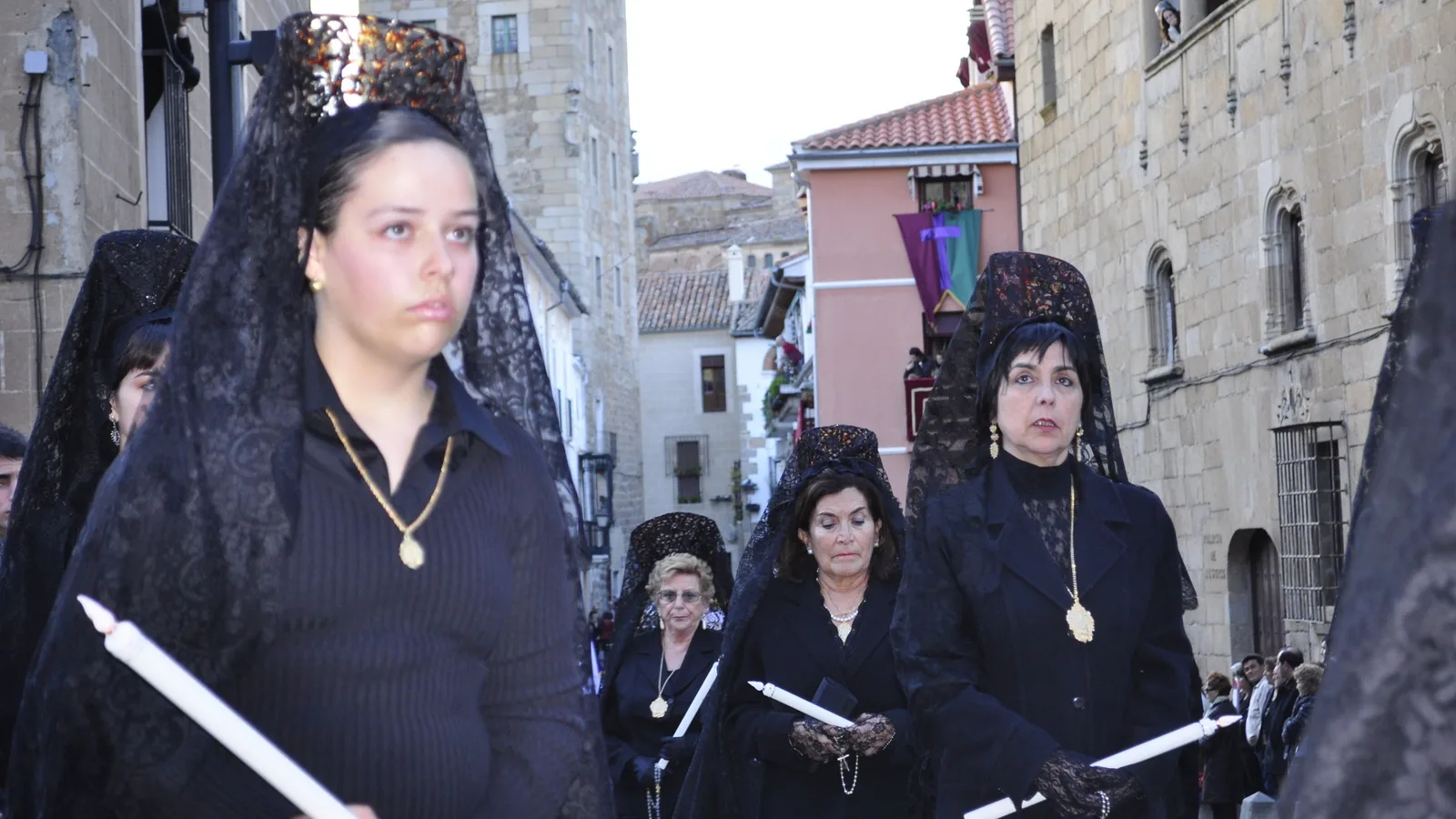
Few garments carry as much baggage as the mantilla. The black or white lace veil, worn high over a tall comb called a peineta, is shorthand for Spain the way a beret is shorthand for France: it appears at Holy Week processions, at bullfights and royal weddings, on opera stages playing Carmen, and on red carpets whenever a designer wants to signal drama. It is also, for many Spaniards, a symbol of piety, conservatism and the Franco years.
Mantilla: Fashion Unveiled, which opened at the Hispanic Society Museum & Library in New York on 20 November and runs until 28 March 2027, sets out to untangle those meanings. Vogue calls it the first major museum exhibition devoted to the object. Its premise is that the veil has never meant just one thing.
What the exhibition is
The museum describes the mantilla as "the most distinctive garment in Spanish women's fashion with origins dating to the 16th century", and promises paintings, textiles, photographs, books and contemporary fashion tracing its evolution "from a symbol of tradition and femininity into a powerful expression of identity and artistic innovation". It is the second instalment of the Hispanic Society's multi-year fashion initiative, which began with Spanish Style: Fashion Illuminated, 1550–1700.
The guest curator is the Spanish-born scholar Carlos Usabiaga López. "The understanding of the mantilla in all its complexity is often limited, either by a superficial reading of the symbol itself or by its association with an old-fashioned, rather conservative image of Spain," he told ELLE's Kristen Bateman. "This exhibition challenges the perception of the mantilla as an anachronistic relic of the past and reclaims its continued cultural relevance and subversive potential."
Usabiaga told Vogue España that he wanted "to give voice to fashion as a political weapon of identity", and to study how Romantic Europe's image of Spain travelled to the United States, a subject he considers "very little studied".
Modesty and seduction
According to Vogue España's Nuria Luis, the show is built around a series of dualities, and the first sets modesty against sexuality. In Spain the veil was tied to religion and to a patriarchal idea of covering the female body, Usabiaga says. "Nevertheless, many chronicles of the period tell how some women, like the Duchess of Alba, used that gesture as a weapon of freedom. Anonymity allowed them to do whatever they liked."
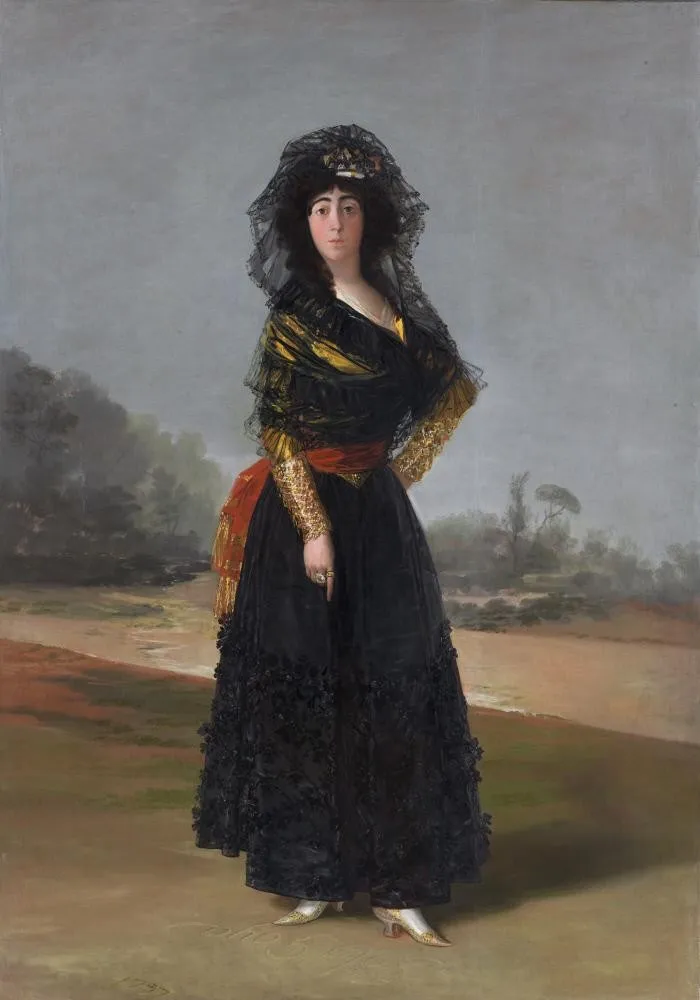

That duchess is the Hispanic Society's great painting of the subject. Goya's 1797 portrait shows María del Pilar Teresa Cayetana de Silva y Álvarez de Toledo, the 13th Duchess of Alba, in black, a mantilla over her curls, pointing at an inscription in the sand. Archer Milton Huntington, who founded the institution, acquired it in 1906.
Usabiaga also points to the veil's class signals. "The functional aspect of the mantilla could always be achieved with any material," he told Vogue España. "It was the quality one could afford that marked status." And he relishes its contradictions: the Virgen de la Macarena in Seville came to wear the mantilla of the actress Juanita Reina, a devotee. "The same garment that serves that more erotic charge now dresses the Catholic, Apostolic and Roman Virgin. That versatility is very interesting."
The Spanish craze
The second strand moves to America. Around the turn of the twentieth century, the United States went through what historians call the "Spanish craze", a fascination with Spain in which, Usabiaga told ELLE, "the mantilla became part of a highly recognizable visual language through which Spain was imagined and represented in America." Spanish performers made fortunes on that image: the dancer Tórtola Valencia, who features prominently, and the singer Raquel Meller, who appeared on the cover of Time in 1926.

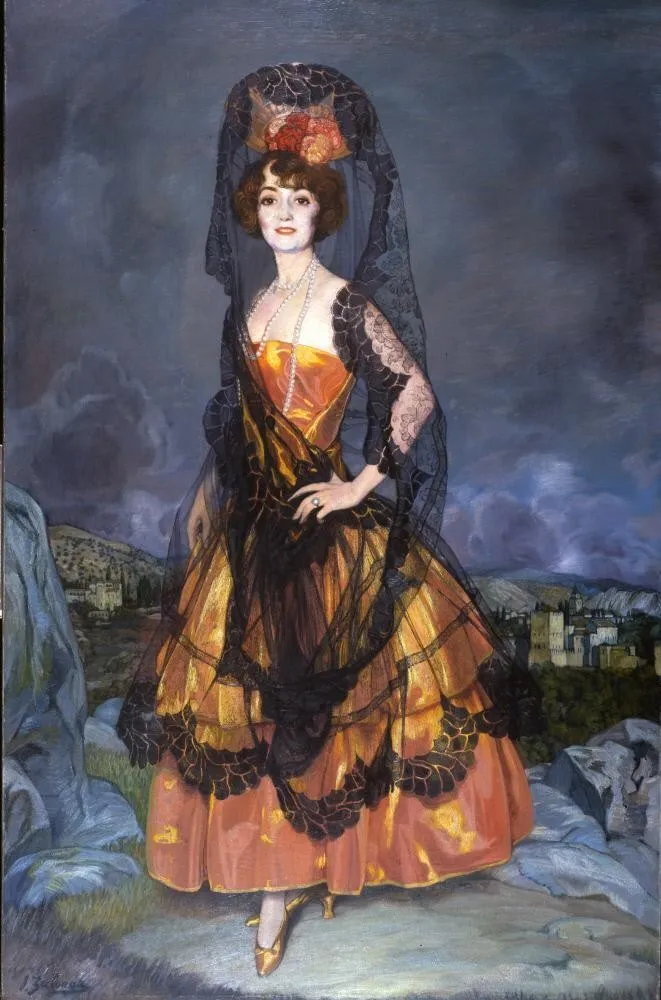
American high society wanted the look too. For Usabiaga, Vogue España reports, the perfect synopsis of the show is Ignacio Zuloaga's 1923 portrait of Millicent Hearst, wife of the newspaper magnate William Randolph Hearst, in an orange dress wrapped in a black lace mantilla and high comb. The curator notes the irony: Hearst's papers had campaigned against Spain during the war of 1898, yet he went on to amass one of the most ambitious collections of Spanish art of his time.

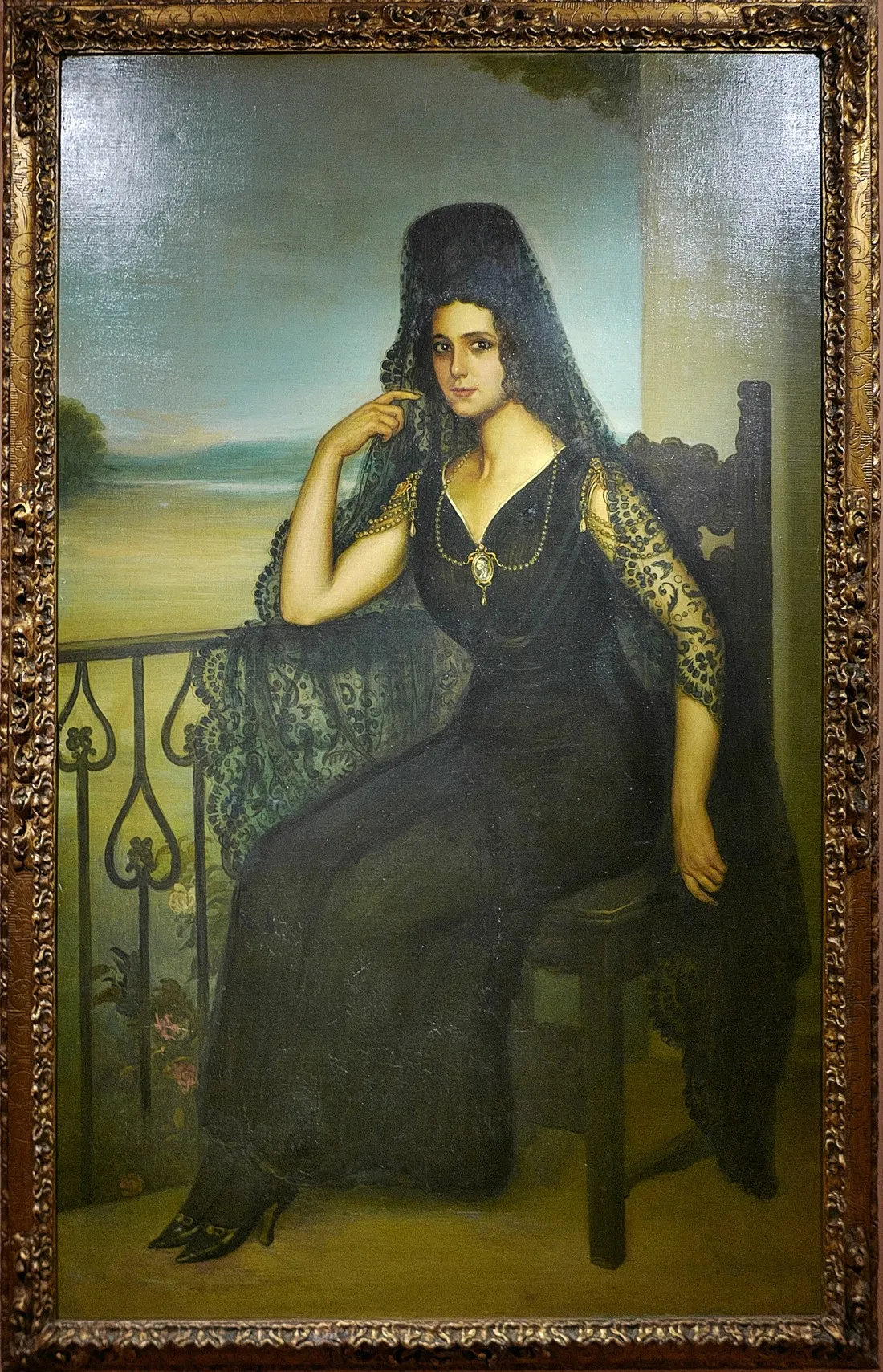
Hollywood fed the cliché. Vogue España cites Rita Hayworth in The Loves of Carmen (1948) and Marlene Dietrich in The Devil Is a Woman (1935), whose combs and veils, it notes, have little to do with the real thing. "Spanish culture in the United States has never been well understood," Usabiaga says. Photographs by Rafael Cubiles of Jacqueline Kennedy and Grace Kelly in mantillas at Seville's Real Maestranza bullring in 1966 show the image coming full circle, with American icons adopting the Spanish costume in Spain.
From La Movida to drag
The third and boldest strand is political. Under Franco the mantilla became an emblem of the ideal Spanish woman. After his death, the countercultural movement known as La Movida Madrileña took it back. Vogue España describes a photograph by Christopher Makos of Pedro Almodóvar in a peineta after filming Matador (1986), and an image of the Sevillian artist José Pérez Ocaña, who performed on Barcelona's Ramblas in women's clothes, arriving at the San Sebastián Film Festival in 1979 in comb, mantilla, Manila shawl and fan, on the arm of the actor and director Pierre Clémenti.
For Ocaña, Usabiaga says, "the fight for rights or the rejection of the fascism that had just been lived through were not opposed to reappropriating those national symbols." The exhibition links him to today's drag artists, including La Carvento, who blends contemporary performance with Andalusian folklore.
The designers
Fashion arrives in the final rooms, and the choices are deliberate. "Throughout the history of fashion, major designers such as Cristóbal Balenciaga and Óscar de la Renta have drawn inspiration from this [Spanish] visual language, including the mantilla," Usabiaga told ELLE. "However, it was a curatorial decision to bring contemporary designers, including emerging voices, into direct conversation with the masterpieces."
So there is no Balenciaga, Vogue España reports. Instead there is haute couture by Juana Martín, a dress with a mantilla from Leandro Cano's 2020 collection A tu vera, inspired by the stars of copla, and a look from Arturo Obegero's Spring/Summer 2025 collection based on El amor brujo. "We wanted to create a sort of mantilla in flames," Obegero told the magazine, describing lace given "a lot of structure to create something brutal and severe", and transposed from a traditionally feminine garment to menswear codes.

Our view
On the evidence available, this is a show with a thesis rather than a parade of pretty lace, and that is its strength. Vogue España calls it one of the most interesting exhibitions of the autumn. By putting Goya and Zuloaga beside Ocaña, drag performers and young designers, Usabiaga makes the case that a national costume is never fixed: it belongs to whoever wears it, and to whatever they want it to say. His closing argument, to Vogue España, is that the veil "is not dead. It is very much alive."
The risk is the one any object-led exhibition runs: that a single garment is asked to carry three centuries of Spanish politics, American fantasy and queer history. Whether the galleries give each strand room to breathe is something only a visit, or the full critical response still to come, can settle. The decision to favour emerging designers over Balenciaga will divide fashion visitors, but it keeps the show's attention on the present rather than on a well-told story about the past.
It also pairs well with other autumn shows about how clothes travel between cultures and meanings. Our Look! review covers Paris; for New York, see our report on New York Fashion at PS1, and the Museum at FIT.
Visiting
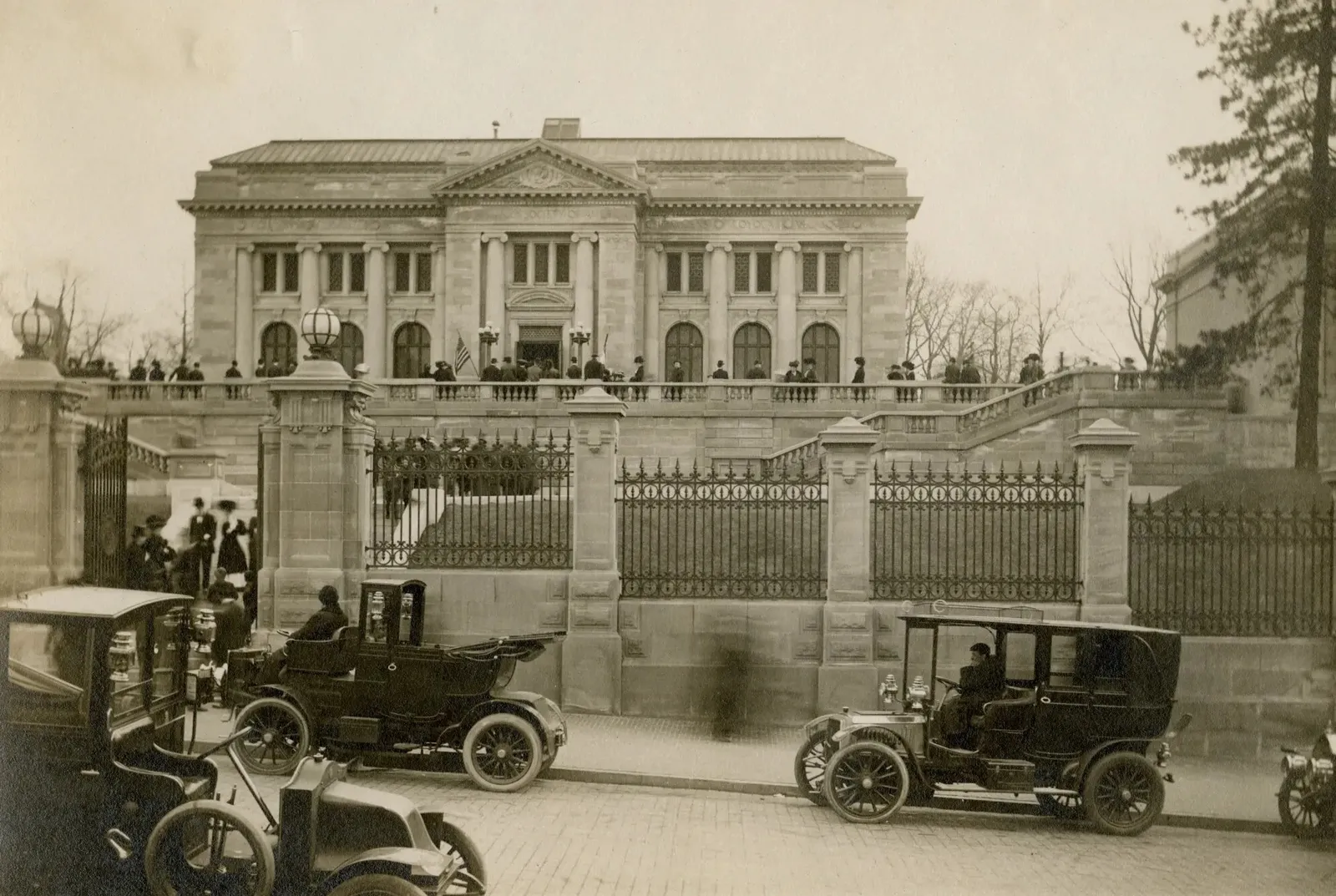
Mantilla: Fashion Unveiled is at the Hispanic Society Museum & Library, 3741 Broadway (between 155th and 156th Streets), New York, from 20 November 2026 to 28 March 2027. The museum is open Thursday to Sunday, noon to 5pm, and is closed on Thanksgiving, Christmas Day and New Year's Day. Admission is free with a timed ticket reserved in advance, with a suggested donation. The nearest subway stations are 157th Street (1 train) and 155th Street (C train).
Frequently asked questions
When does Mantilla: Fashion Unveiled close?
On 28 March 2027. It opened on 20 November 2026.
Who curated it?
Carlos Usabiaga López, a Spanish-born scholar, as guest curator for the Hispanic Society Museum & Library.
What is on show?
Paintings, textiles, photographs, books and contemporary fashion, from Goya's 1797 portrait of the Duchess of Alba and Zuloaga's 1923 portrait of Millicent Hearst to photographs of Pedro Almodóvar and José Pérez Ocaña and designs by Juana Martín, Leandro Cano and Arturo Obegero.
Is it free?
Yes. Admission to the Hispanic Society is free, but visitors must reserve a ticket in advance; a donation is suggested.
Featured image: Jose Antonio Cotallo López, CC BY 2.0, via Wikimedia Commons. Cropped for this page.
