
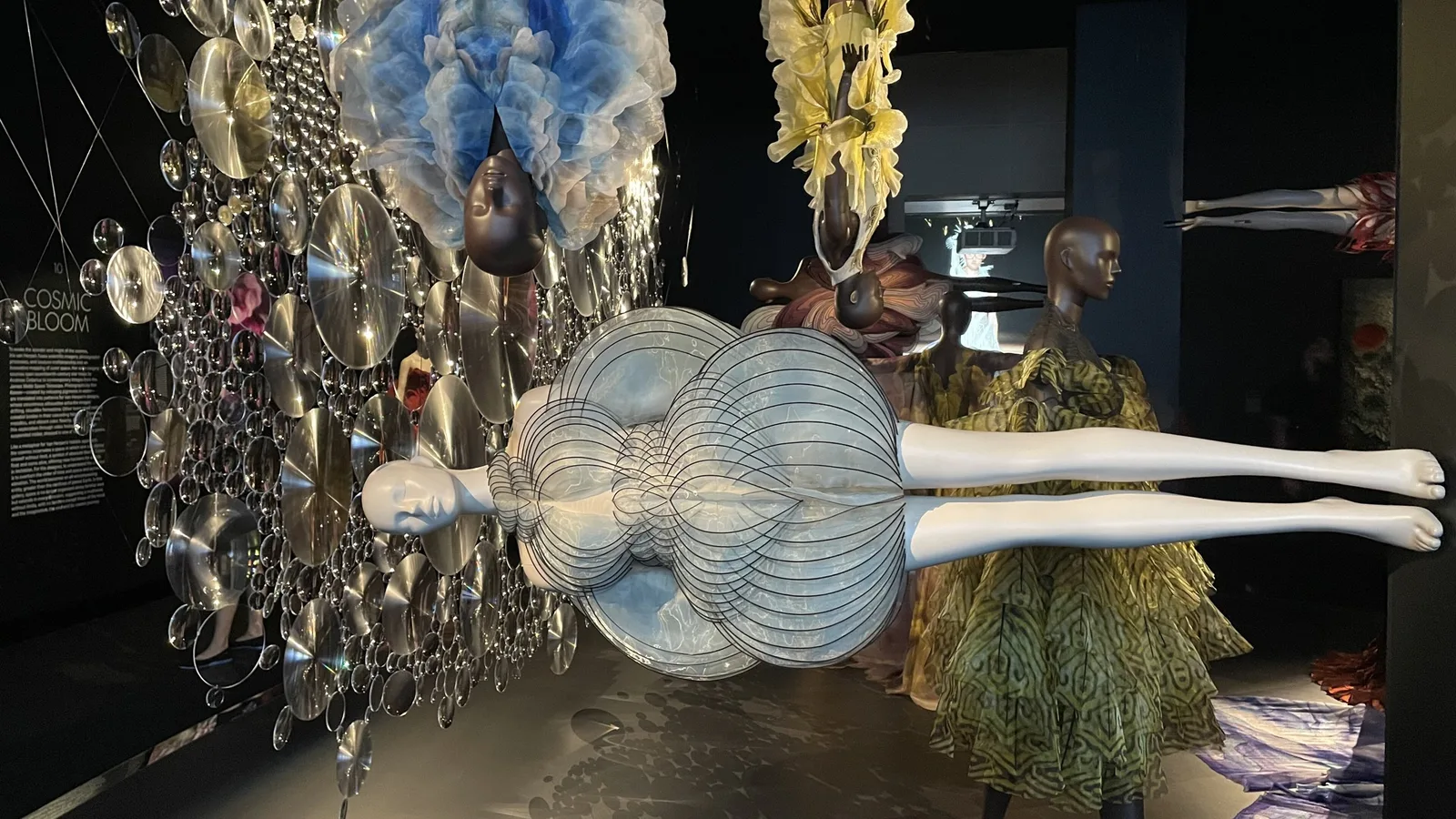
A note on this review: Casadi has not seen the exhibition in person. This piece describes the show from the Brooklyn Museum's published details and the reporting of critics who have, and weighs their arguments. Every judgement below is attributed.
Most fashion retrospectives are organised around a designer's biography: the early years, the breakthrough, the famous clients. Iris van Herpen: Sculpting the Senses is organised around water, motion, sound, light and the stars. The touring exhibition, first staged by the Musée des Arts Décoratifs in Paris in 2023, opened at the Brooklyn Museum on 16 May 2026. It is the show's North American debut and, the museum says, the first major New York presentation of the Dutch couturier's work. Following what the museum called "an enthusiastic response from visitors and critics", it has been extended by four weeks, to 3 January 2027.
For readers in Australia, the show will be familiar: before New York it travelled to the Queensland Art Gallery | Gallery of Modern Art (QAGOMA) in Brisbane, then to Singapore's ArtScience Museum and Kunsthal Rotterdam.
What the exhibition is
The Brooklyn Museum shows more than 140 haute couture pieces alongside contemporary art and design and loans of scientific artefacts and natural history specimens, including coral, fossils and skeletons. Artists in the show include Philip Beesley, Rogan Brown, Casey Curran, Kim Keever, Nick Knight, Tara Donovan, James Turrell and Tim Walker. A soundscape by the composer Salvador Breed runs throughout. The exhibition was curated in Paris by Cloé Pitiot and Louise Curtis; the Brooklyn presentation is organised by Matthew Yokobosky, the museum's senior curator of fashion and material culture, with Imani Williford.
According to Vogue's Laird Borrelli-Persson, the show unfolds across 11 themed sections, and visitors are met first by van Herpen's 2016 Seijaku bubble dress. Yokobosky told Vogue that the route "begins with the blue of water and ends with the blue of the cosmos". On the way, it passes through a room on myth and fear, where Vogue placed the 2011 Capriole Snake dress, and on to an atelier, the cosmos and a wall of the celebrities who have worn her work.
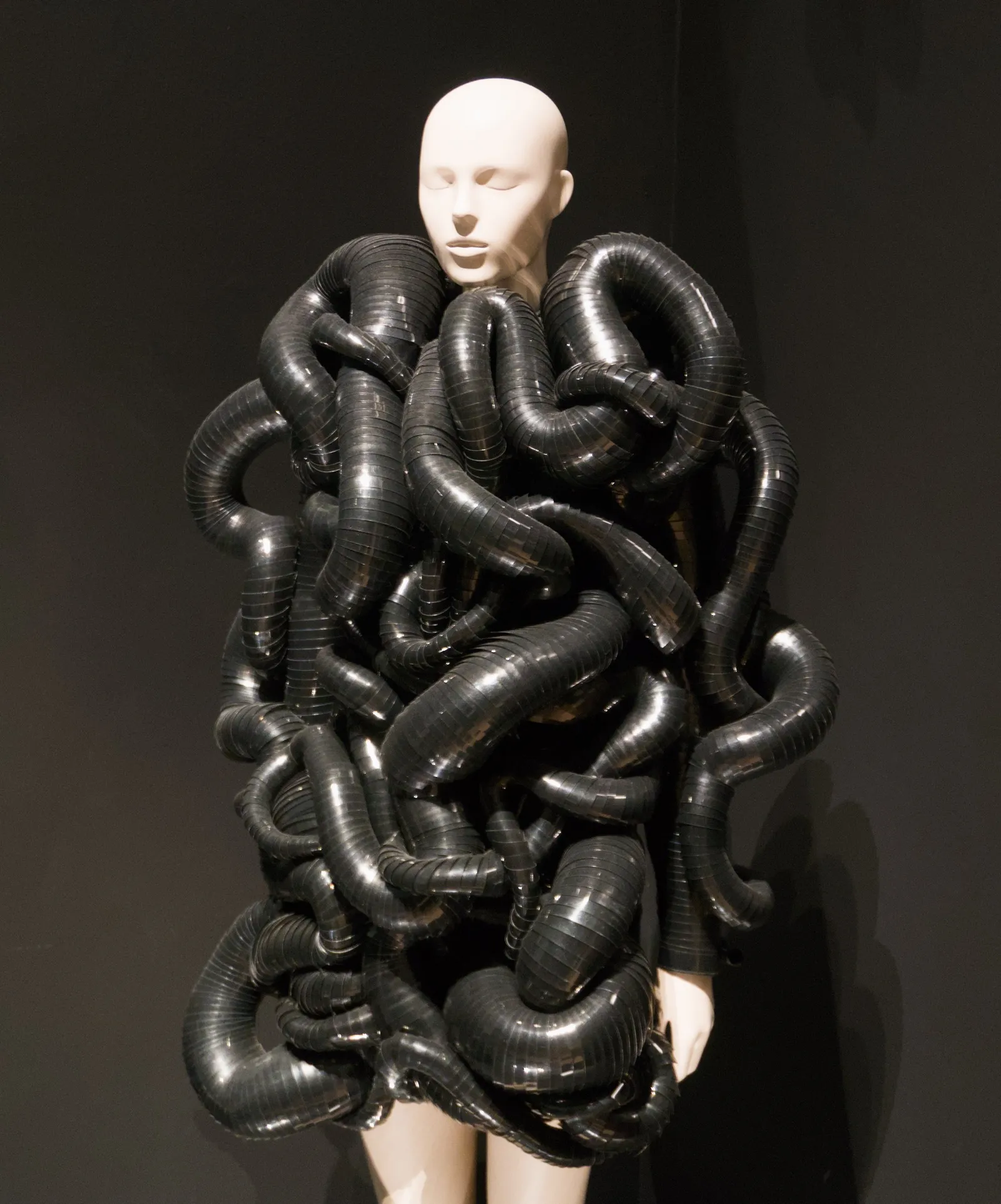

The highlights most cited by critics are:
- The living dress. A garment made of 125 million bioluminescent algae, which, Vogue reports, has made the trip to Brooklyn "encased in glass and regularly refreshed with mist".
- The Met Gala connection. The bubble dress at the entrance is a precursor to the Airo dress that van Herpen made with the studio A.A. Murakami for Eileen Gu at the 2026 Met Gala, which Artnet describes as set with thousands of glass spheres.
- Celebrity loans. Beyoncé lent the dress van Herpen made for her Renaissance tour; Grimes's 2021 Met Gala look is shown, as is the red costume van Herpen designed for Anne Hathaway in David Lowery's film Mother Mary.
- Brooklyn's own additions. The museum commissioned a new video installation, Craftolution (2026), about van Herpen's atelier, and the show includes a recreated version of her atelier, where she has worked with visitors in person.
Context matters here. Van Herpen, born in 1984 in Wamel in the Netherlands, trained as a dancer before studying fashion at ArtEZ, and founded her house in Amsterdam in 2007. Her Crystallization collection of 2010 included what is widely credited as the first 3D-printed dress shown on a runway. Vogue calls her one of the few designers "to convincingly and organically introduce technology to couture".
The case for
The reviews have been notably warm. In Vogue, Borrelli-Persson called the exhibition's choreography "well-done", praising how it travels "from the micro to the macro", and compared it favourably with the Met's own spring show: if Costume Art examines "the topography of the body", she wrote, Sculpting the Senses "drills down much deeper, to the molecular level".
Artnet's Min Chen described the show as "quite unlike a fashion exhibition", with Ernst Haeckel's illustrations and a fossil some 50 million years old sharing the galleries with the clothes. Van Herpen's own explanation, given to Artnet, is the clearest summary of the thesis: "Nature is the best artist that we have on this planet." To Vogue she framed it as a broader argument about fashion's place: "When fashion stays within its own bubble, it's not responding to the world."
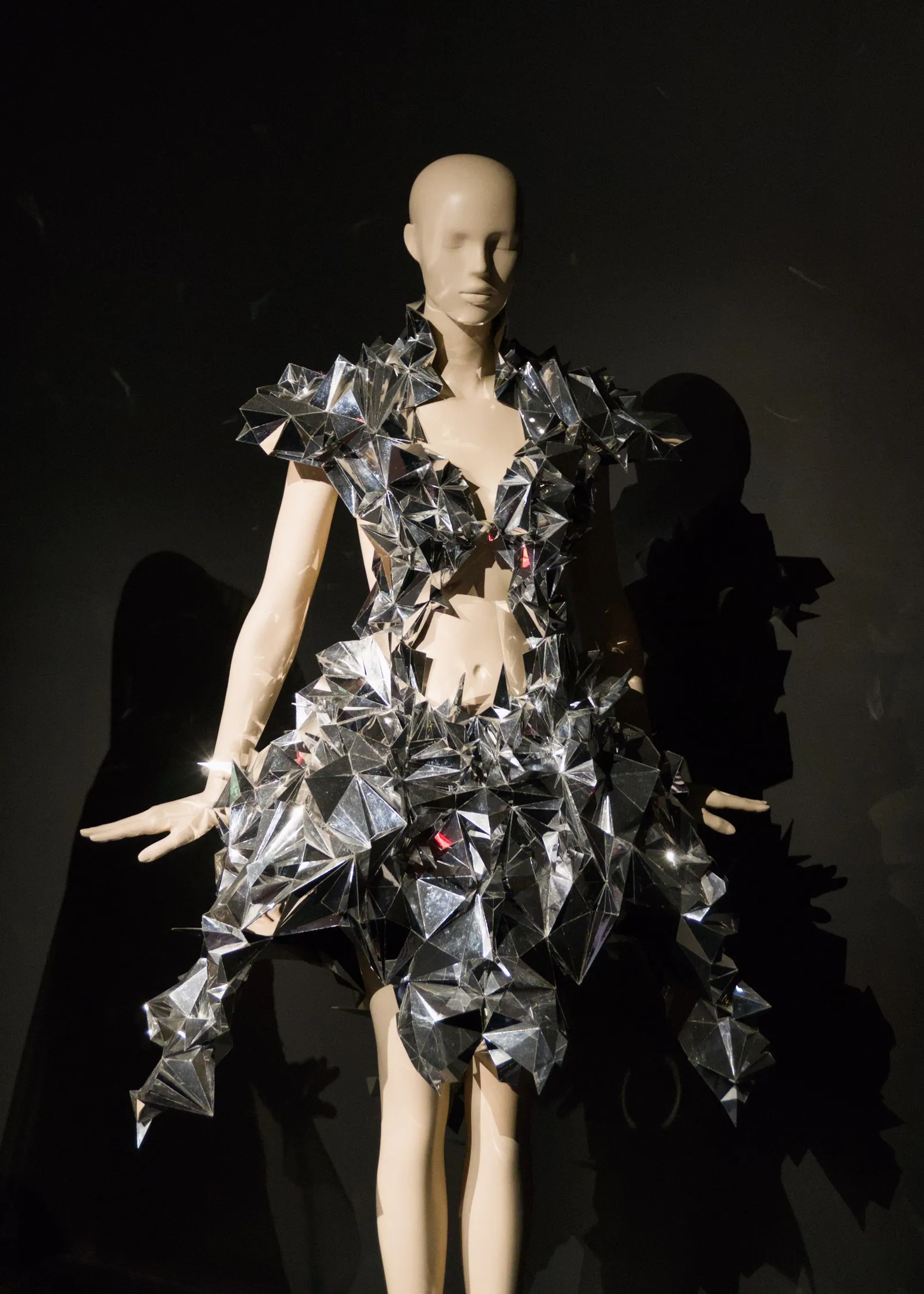

In The Wall Street Journal, Laura Jacobs titled her review "Fashioning a Singular World" and summed up the designer's "omnivorous view, influenced by ancient fossils, cutting-edge science and the natural world". "Creation," she wrote, "is what Ms. Van Herpen is all about."
The most unusual element is participatory. Hyperallergic's Livia Caligor joined van Herpen in the recreated atelier to hand-pleat fabric for a garment that grows over the run. "Hands are like a language," the designer told her. "My atelier is my most sacred space." The museum says the designer returned for a final series of these performances, Sculpting the (Un)Spoken, from 30 October to 1 November, with fragments of visitors' conversations to be embroidered inside the finished dress.
The case against
There is very little of it in print. The one consistent reservation concerns the celebrity element. Borrelli-Persson wrote that "a wall of muses (photos of celebrities wearing van Herpen) feels self-serving", before concluding that it was "a blip in a show, and a career, that is all about connections, continuity, and movement".
The other caveats are about context rather than quality. This is not a new exhibition: it was conceived in Paris three years ago and Brooklyn is its fifth stop, so visitors who saw it in Brisbane, Singapore or Rotterdam will recognise much of it, although Brooklyn has added Craftolution and its own loans. And a show built so firmly on science, art and spectacle may leave visitors who want to understand how a couture house runs, or what van Herpen's clothes cost and who buys them, with fewer answers.

Our view
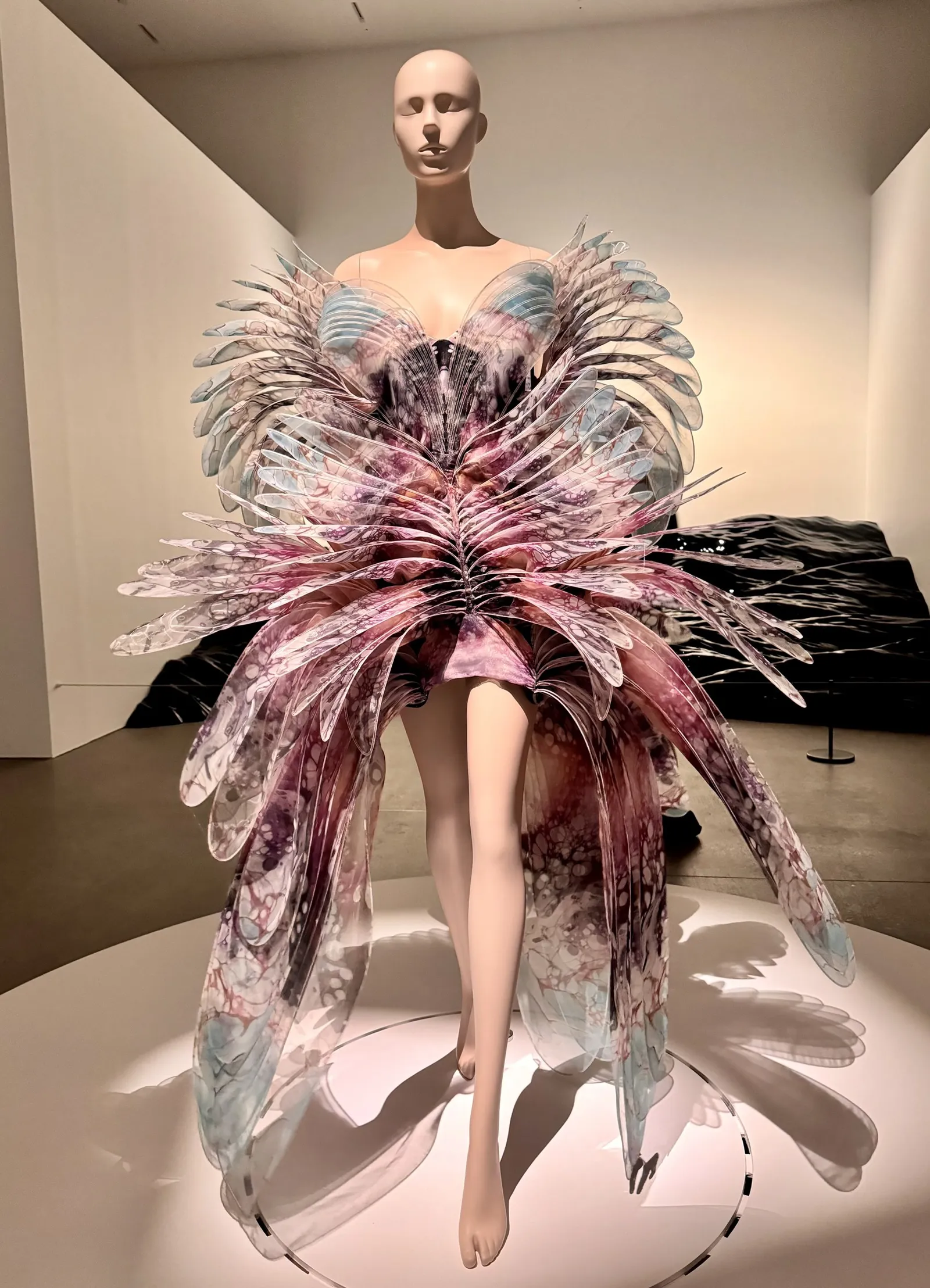
On the evidence of the reviews, Sculpting the Senses is the rare fashion exhibition whose subject is not fashion. Its argument, that couture can be a way of thinking about the natural world, is unusually ambitious, and critics from Vogue to the Wall Street Journal agree that the staging makes the case. The celebrity wall is a reminder that even the most cerebral designer depends on red carpets, but it appears to be a small part of a large show.
It also makes a useful pairing. Until 10 January, New York has two major fashion exhibitions running at once: the Met's *Costume Art*, which, in Vogue's phrase, examines "the topography of the body", and Brooklyn's, which looks past the body to the natural world. Seen together, they make a strong case for fashion as a museum subject.
Should you go?
If you are in New York before 3 January, yes, especially if you have not seen the show on its earlier stops. Book a timed ticket in advance, and allow time for the recreated atelier and the Craftolution video installation. If you saw it in Brisbane, the reviews suggest the Brooklyn version is broadly the same exhibition, with Craftolution and the New York loans as the main additions.
Visiting
| Visiting | Details |
|---|---|
| Venue | Brooklyn Museum, 5th floor (Morris A. and Meyer Schapiro Wing and Iris and B. Gerald Cantor Gallery), 200 Eastern Parkway, Brooklyn, New York |
| Dates | 16 May 2026 – 3 January 2027 (extended from 6 December 2026) |
| Hours | Wednesday–Sunday, 11 am–6 pm; closed Monday and Tuesday, Thanksgiving, Christmas and New Year's Day |
| Tickets | Timed tickets required; book through the museum |
| Getting there | 2/3 subway to Eastern Parkway–Brooklyn Museum |
| Programmes | Member Mornings, 7 November; A Close Look (ages 65+), 10 November; Pop-Up Talks, 21 November |
| Audio guide | Bloomberg Connects app |
| Organised by | Musée des Arts Décoratifs, Paris; Brooklyn presentation supported by the Simons Foundation's "Infinite Sums" initiative |
Dates, hours and programmes from the Brooklyn Museum's exhibition and visitor pages, checked 3 November 2026.
Featured image: Brooks patty, CC BY-SA 4.0, via Wikimedia Commons. Cropped for this page; the cropped version is shared under the same CC BY-SA 4.0 licence.
