

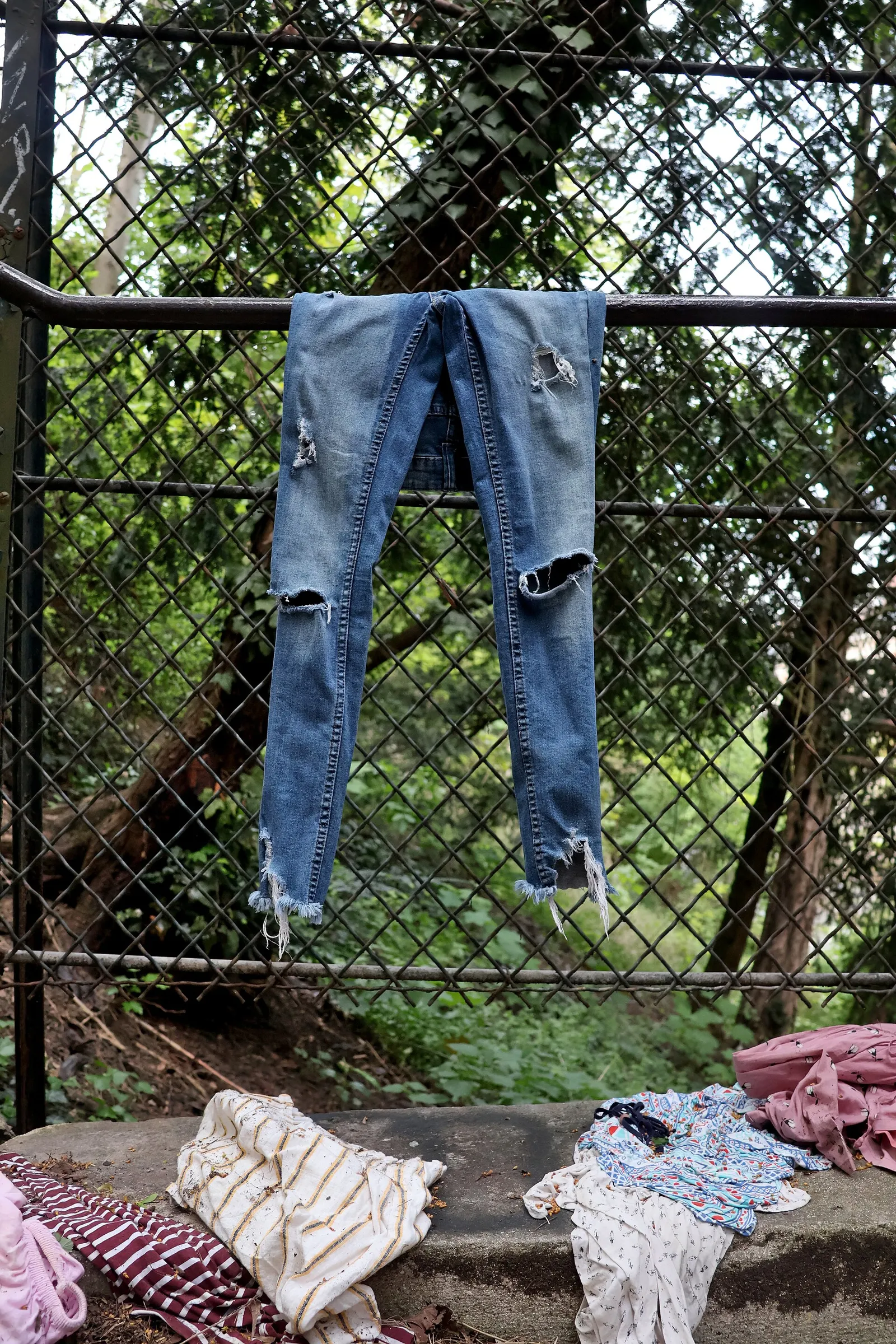
For several seasons the most expensive clothes in fashion were also the most perfect: the unmarked cashmere, the pressed trouser, the leather without a crease that came to be called quiet luxury. That ideal is now being roughed up. On the autumn/winter 2026 and spring/summer 2027 runways, designers have sent out shirts with stained cuffs, coats peeling at the seams, satin marked with rust, scuffed shoes and jeans torn at the knee. As ELLE put it in a trend report this week, "the runways are ripe with notes of distressing and deconstruction."
The look is deliberate, and it is expensive. Here is where it showed up, why it is happening now, and what it means for anyone deciding what to buy.
The key facts
- The trend: clothes made to look worn, stained, frayed, faded or repaired, from tailoring to leather goods and denim
- Who is doing it: Prada for autumn/winter 2026, men's and women's; Miu Miu and Coach, with aged leathers; and for spring/summer 2027 Louis Vuitton, Gucci, Valentino, Diesel, JW Anderson, Balenciaga and Ann Demeulemeester, according to ELLE
- The key piece: frayed and ripped jeans, which ELLE reports appeared at Ann Demeulemeester, Balenciaga and Diesel for spring 2027
- The expert view: Valerie Steele of The Museum at FIT links it to a sense that fashion has drifted out of touch with real life
Prada's archaeology
The clearest statement came from Prada. Miuccia Prada and Raf Simons showed their autumn/winter 2026 menswear in January at the Fondazione Prada in Milan, in a set designed by OMA to look like the cut-away ruins of an Italian palazzo. "It's a kind of archaeology," Simons said backstage, according to Wallpaper. Shirt cuffs were gently stained and soiled, leather outerwear was creased across its surface, and one fabric was peeled away in patches to reveal houndstooth underneath, like old wallpaper.
Simons explained the idea in terms of the businessman's or politician's shirt. "You can transform that in two steps, in three steps, in four steps," he said. "What if you made the stripes horizontal? What if you gave it a T-shirt neckline? What if you age it? It's about transforming things that you respect and love."


The women's show in February went further. WWD's Miles Socha described clothes that were "decayed, ravaged, fraying and purposely soiled," layered and unlayered as 15 models walked the runway four times, with crinkled trench coats peeling at the seams to reveal checked wool beneath. ELLE singled out crystal-covered pointed heels that looked as if they had stepped in a puddle of dirty rainwater. The counterweight was pure luxury: small bucket and top-handle bags in polished alligator. Simons told WWD that he and Mrs Prada imposed no hierarchy between minimal and opulent, or between pristine and damaged.
Worn to death, or to eternity
If Prada treats wear as a layer of history, Stefano Gallici at Ann Demeulemeester treats it as weather. His spring/summer 2027 collection, Lonesome Heaven, grew out of a solo trip across the Californian desert, he told WWD, and it evoked what the paper's Sandra Salibian called a "sun-bleached decay": faded prints, distressed denim, bleached cargo trousers, rust stains on workwear, frilled dresses and ballet flats, destroyed tuxedos and tailoring turned inside out so the linings showed, and aviator-style leather jackets with a lived-in patina.
Hypebeast noted the line in Gallici's notes that sums up the season: a tuxedo imagined "worn to death, or to eternity." That phrase captures the double meaning of the trend. Wear can signal decline, but it can also signal permanence: the garment that has lasted.
Where it came from
None of this is new, and its history is worth knowing. Vivienne Westwood's punk clothes, the deliberately holed knitwear of Rei Kawakubo and Martin Margiela's deconstruction all made damage into a design language, and ELLE also cites Alber Elbaz. The damaged jeans of the Y2K years and 1990s grunge are the more recent ancestors of the frayed denim on this year's runways.
The most famous recent example was a provocation. In May 2022 Balenciaga, then under Demna, launched its Paris Sneaker with a limited run of 100 "extra destroyed" pairs at $1,850, CNN reported, while less battered versions sold for $495 and $625. Balenciaga said the campaign images, which showed the shoes "extremely worn, marked up, and dirtied," suggested that the sneakers were "meant to be worn for a lifetime." The internet mostly laughed. Four years later, much of the industry has followed.

Why now
Valerie Steele, director and chief curator of The Museum at the Fashion Institute of Technology in New York, offered ELLE a blunt diagnosis. "There is kind of a crisis in fashion right now," she said. "Fashion has started to seem really out of touch with real life and real people." She pointed to luxury pricing, and to an interest in "what 'real people' wear," while warning that authenticity is something of "a chimera" in a commodified world.
Pricing is part of the story. After years of increases, Gucci has cut some of its prices by as much as 30 per cent, as we reported in our analysis of Kering's price reset. A look that says "I have had this for years" suits a moment when shoppers are questioning what newness is worth.
Steele also argues that the impulse is very old. In the second half of the 19th century, she told ELLE, some male dandies cultivated a deliberately unpolished look, and wealthy Bostonians who bought couture in Paris would keep it in a trunk for a year so that it would not look so new when they first wore it. The idea, she said, is that "the sort of shiny newness of fashion may seem a little bit fashion victim-y." Or, more simply: "If scuffing your shoes is gonna make them more fashionable, then you go for it, right?"


The look has also moved beyond the runway. ELLE points to Distressed Fest, a twice-yearly vintage pop-up on both American coasts that sells heavily worn, threadbare and destroyed garments at a premium. Real wear, in other words, is now a selling point.
How to wear it
- Start with denim. A frayed hem or a single worn knee is the easiest way in, and the piece most likely to last beyond the trend.
- Pair damage with polish. Prada's lesson is contrast: one worn piece reads as intentional when everything around it is sharp, as with the runway's scuffed shoes and immaculate alligator bags.
- Consider the real thing. Genuinely worn vintage, a mended jacket or a leather bag with its own patina delivers the same message, often for less, and keeps clothes in use.
- Look after it. Pre-distressed garments can be more fragile than they look. Check how a frayed edge or a peeled surface has been finished before buying, and follow the care label.
Our view
It is easy to mock clothes sold to look already used, and the critics have a point: paying a premium for a manufactured stain is a strange way to signal authenticity. Even WWD, admiring Prada's ideas, ended its review with a plea to "hold the mess".
But the distressed moment is more interesting than a gimmick. It is a reaction against a decade in which luxury meant flawlessness and constant newness, and it carries an idea worth taking seriously: that clothes gain character through use, and that the best ones are made to be worn hard and kept. If the trend persuades people to wear what they own until it looks like this, it will have done more good than most. If it only sells new jeans with holes in them, it will pass, as it always has, until the next time.
For more on the season's shifts, see our guide to autumn/winter 2026 and our review of the Milan spring/summer 2027 shows.
Frequently asked questions
Is distressed fashion back in 2026?
Yes. Prada showed deliberately stained, frayed and peeling clothes for autumn/winter 2026, and ELLE reports worn-in looks at Louis Vuitton, Gucci, Valentino, Diesel, JW Anderson, Balenciaga and Ann Demeulemeester for spring/summer 2027.
Are ripped jeans coming back?
Frayed and ripped jeans appeared on the spring/summer 2027 runways at Ann Demeulemeester, Balenciaga and Diesel, according to ELLE, alongside a wider revival of late-2000s style.
Why are designers making clothes look worn?
Designers frame it as history and change: Raf Simons called Prada's men's collection "a kind of archaeology". The fashion historian Valerie Steele links the trend to a sense that fashion has seemed out of touch with real life, and to luxury's high prices.
Is distressed fashion new?
No. Punk, Rei Kawakubo's holed knitwear, Martin Margiela's deconstruction, 1990s grunge and Y2K denim all used damage deliberately. Steele traces the instinct back to 19th-century dandies and to wealthy Bostonians who aged their Paris couture before wearing it.
What was the Balenciaga destroyed sneaker?
In May 2022 Balenciaga sold 100 pairs of an "extra destroyed" version of its Paris Sneaker for $1,850, while less distressed versions cost $495 and $625.
Featured image: Imani Bahati, CC0 1.0, via Wikimedia Commons. Cropped for this page.
