
A note on this review: Casadi has not yet seen the exhibition in person. This piece describes the show from Tate's published details and the reporting of critics who have, and weighs their arguments. Every judgement below is attributed.
The 90s: Art and Fashion, which opened at Tate Britain on 8 October 2026 and runs until 14 February 2027, is curated by Edward Enninful, the former editor of British Vogue, and sets the decade's fashion photography and design beside the art of the Young British Artists and their contemporaries.
The reviews have been sharply polarised. The Independent awarded it five stars. The Guardian's critic called it "a magazine spread", and The Times called it a "disaster". The disagreement says a great deal about how museums now handle fashion.
What the exhibition is
Tate describes a show in which "art, design, fashion and photography" fuse "into one potent cultural force" as Britain emerged from recession, and says it is informed by Enninful's "lived experience of the decade".
It brings together photographs by Juergen Teller, David Sims and Corinne Day; work by artists including Steve McQueen, Damien Hirst, Sarah Lucas and Yinka Shonibare; fashion film and music culture; and collections by Vivienne Westwood, Alexander McQueen and John Galliano. Teller's 1998 photograph Young Pink Kate, of Kate Moss, is the show's lead image. Tate says the exhibition is supported by McQueen.
Reviewers describe seven rooms, organised by theme. According to The Nerve's Ben Luke, they include "Body Shock", which sets Alexander McQueen pieces beside fashion photography and art about the body; "Less Excess", which pairs minimal art with pared-back fashion; and "Nation's Finest", devoted to Black artists, photographers and designers. Another room is given entirely to Steve McQueen's 1993 film installation Bear.
The case for: The Independent
Stephen Armstrong's five-star review is the show's strongest defence. "Edward Enninful has pulled off something remarkable," he writes. "He has captured a spark of that incredible decade," which he places between the fall of the Berlin Wall and the fall of the Twin Towers, "when anything seemed possible and usually was."
He praises the sequencing: the opening room of photographs and paintings of women, led by Corinne Day; a "bedroom" with Sarah Lucas, Chris Ofili and Tracey Emin; and a clubbing room in which Mark Leckey's film Fiorucci Made Me Hardcore "is the pivot here, around which the whole exhibition spins". He also notes that Galliano is "footnoted, with a strong condemnation of his antisemitic outburst in 2011", a pointed detail in the year the Met cancelled its planned Galliano retrospective, which we covered in our Met Gala 2027 explainer.
His conclusion is that the show is "a portrait of a young, democratic and hopeful time", and that the hope on its walls is heartbreaking because it does not seem to have gone anywhere.
The headlines on two other reviews, which sit behind paywalls, suggest a warmer reception too. The Financial Times ran its review under "a riotous, revisionist version of Britain"; The Telegraph called the show a "salty celebration of the 1990s" that "nails the raw appeal of a defiant decade".
The case against: The Guardian, The Times, The Arts Desk and The Nerve
Elsewhere, the criticism is fierce and remarkably consistent.
Jonathan Jones in The Guardian argues that the format itself fails. "This is not a real exhibition. It's a magazine spread," he writes. "If you take the fashion images seriously you reduce the art to another stylish pose. If, like me, you care about the art, the fashion looks pretty vacant." He finds the Young British Artists thinly represented, noting that Rachel Whiteread appears through "an early cast of the inside of a hot-water bottle", and complains that "after just seven rooms it suddenly ends".
Waldemar Januszczak in The Times calls the show "a daft effort" and argues that it "feels more like an enlargement of Enninful's preferred lifestyle than a serious assessment of the decade's cultural worth". On Whiteread's single work, he writes: "It's like commemorating the building of Tate Modern with a thimble of cement."
Sarah Kent in The Arts Desk says the show "starts well", with Sarah Lucas's boots and Chicken Knickers, but argues that Enninful "trivialises" key works "with juxtapositions that are either meaningless or downright insulting". She objects in particular to Hamad Butt's glass sculptures being placed alongside McQueen pieces, and to Chris Ofili's No Woman, No Cry, a painting dedicated to Doreen Lawrence, hanging near photographs of sharply dressed young men and a vitrine of tailored jackets.
Ben Luke in The Nerve quotes Enninful's stated aim that the show is "not an exercise in nostalgia but… a form of critical reflection", then argues that it falls short of it. He finds the opening "an antechamber of reminiscence", notes the absence of Glasgow artists such as Douglas Gordon and the late Christine Borland, and suggests that "with one or two exceptions, the show should be called 90s London: Art and Fashion". His verdict: "a middling cover version of a V&A spectacle".
Where the critics agree
Read side by side, the reviews converge on a few points.
- The McQueen room is the flashpoint. Jones, Januszczak, Kent and Luke all single out the McQueen room, with its metal pieces and the dramatic photography around them, as among the show's weakest, though Armstrong reads the same room as a bridge between the losses of the late 1980s and the joy of the 90s.
- Some artists rise above the hang. Sarah Lucas wins praise from almost every critic. Januszczak says Sonia Boyce, Maud Sulter and Yinka Shonibare "are too good to be overwhelmed", and that Corinne Day is rightly given "her flowers" as "a genre-changing photographer". Luke calls Steve McQueen's Bear "magnificent" and its room the proof of what a less jarring hang could achieve.
- The display decides the argument. The clearest example is Leckey's film: for Armstrong it is the show's pivot; for Luke it is "tossed away on a tiny monitor".
Our view
On the critics' evidence, The 90s works best as a portrait of one editor's decade and least well as the definitive survey the period may deserve. Its strongest passages seem to be those in which a single artist or photographer is given room: Day, Lucas, Steve McQueen. Its weakest appear to be the pairings that ask a fashion photograph and a work of conceptual art to carry the same weight.
That tension is not unique to Tate. Our review of Costume Art at the Met found critics making similar arguments about fashion and fine art sharing a gallery. Fashion clearly brings visitors to museums. The harder question is whether the art comes out of the encounter diminished.
Should you go?
If you lived through the decade, or are curious about its images, yes, with expectations calibrated. Go for Corinne Day's photographs, Sarah Lucas and Steve McQueen's Bear, and read the pairings sceptically. If you are hoping for a full history of British art in the 1990s, the critics suggest you will leave wanting more.
Visiting
- Where: Tate Britain, Millbank, London SW1P 4RG
- When: until 14 February 2027, 10.00–18.00 daily; open until 22.00 on Friday 13 November for Late at Tate Britain
- Tickets: £22, £20 concessions, free for Tate Members
- Note: Tate advises that one room contains flashing lights
For more exhibitions, see Casadi's guide to fashion museums, and for more reviews, visit the Journal.
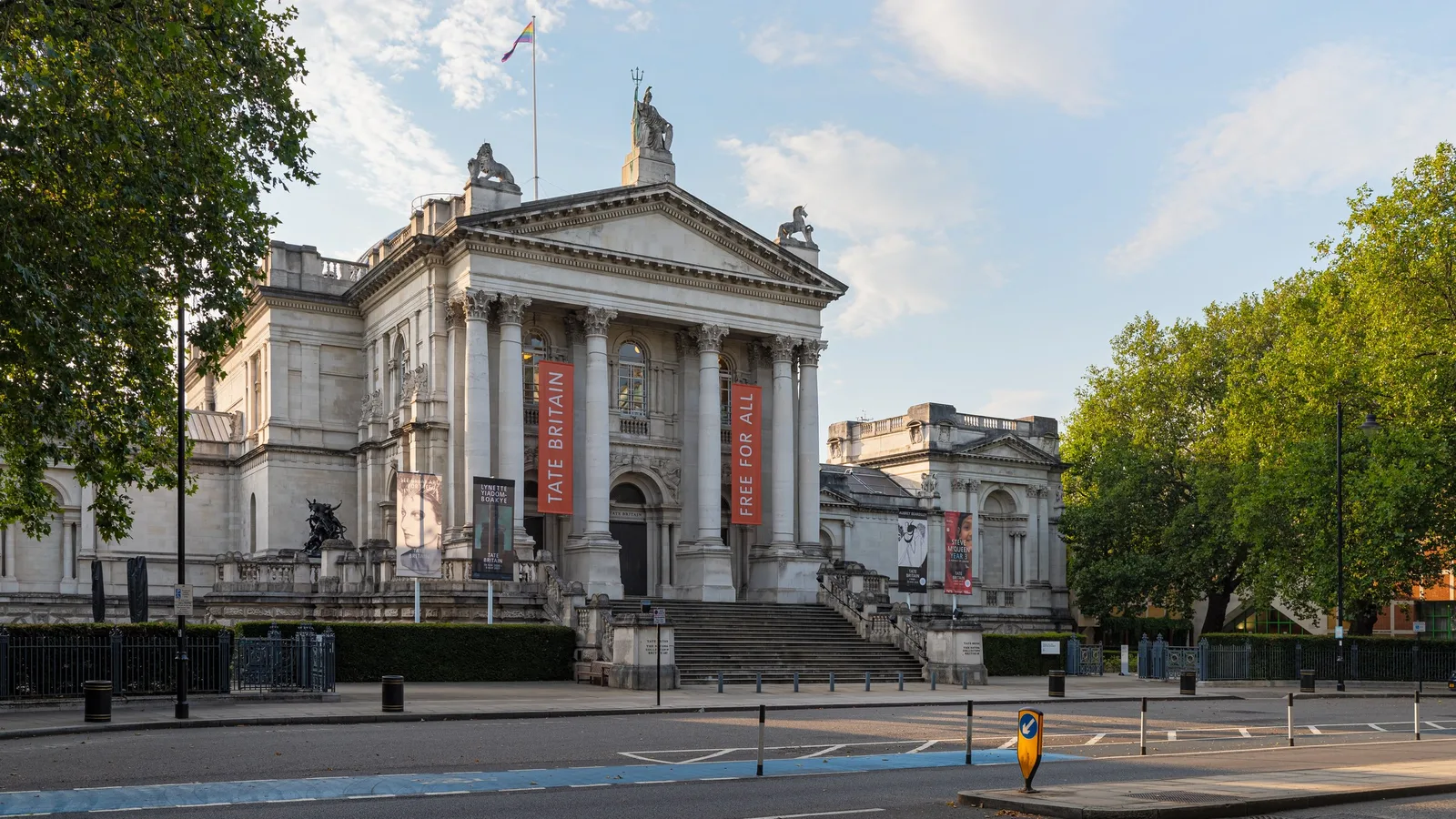
Featured image: Julian Herzog, CC BY 4.0, via Wikimedia Commons. Cropped for this page.
