
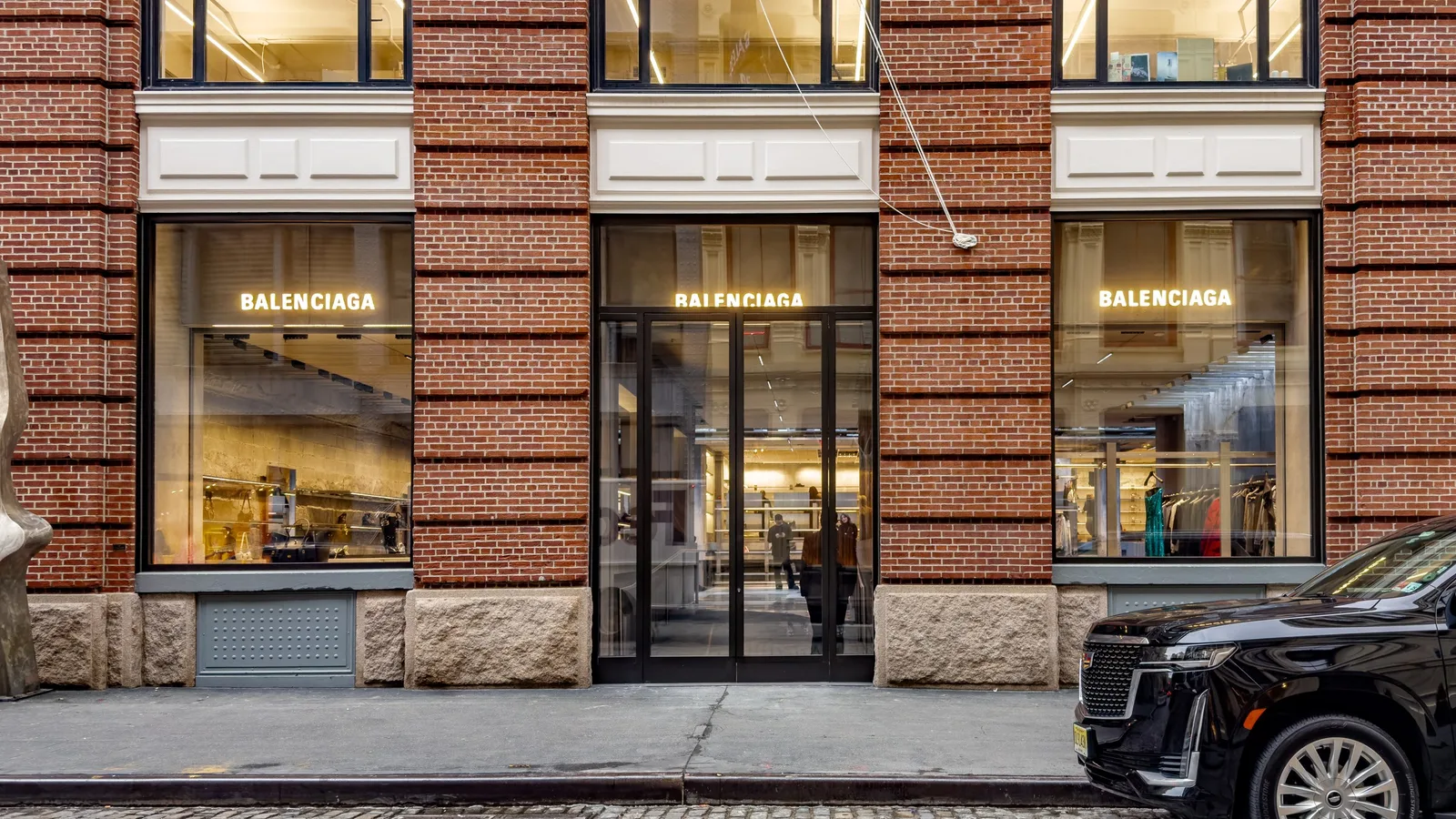
Kering moved quickly. On Thursday 5 November, Balenciaga announced that Pierpaolo Piccioli was leaving as creative director. The next day, the group named his successor: Martine Rose, the London designer whose eponymous menswear label has been one of the most influential of the past decade. She starts on 16 November and will be based in Paris.
Rose is the first woman to lead Balenciaga creatively in the house's 109-year history, and, as The Guardian notes, only the second Black woman to lead a major European house, after Grace Wales Bonner was named men's creative director at Hermès in 2025. She will oversee both the men's and women's collections.
"It is a true privilege to be appointed Creative Director of Balenciaga, a House with an extraordinary heritage and a fearless creative spirit," Rose said in Kering's announcement. "Balenciaga has been shaped by remarkable creative talents before me. I am committed to honoring this legacy and look forward to creating the next chapter in this rich and beautiful story."
A return, not an arrival
Rose knows the house. According to Vogue, she worked at Balenciaga as a menswear consultant from 2015 to 2018, just as Demna was developing the oversized silhouettes that came to define his decade there. The Guardian credits her with helping to shape that signature identity. Inside Retail Asia puts the appointment plainly: Rose is "a direct line to the Demna years".
That makes the choice a clear change of course. Piccioli, who spent 25 years at Valentino, was hired in May 2025 to take the house away from streetwear and provocation and back towards the couture roots of Cristóbal Balenciaga. He showed his first collection, for spring/summer 2026, in Paris in October 2025 and his first couture collection in July this year. Vogue counts three seasons in the role.
In its statement on his departure, Balenciaga's president and chief executive, Gianfranco Gianangeli, said Piccioli had "reaffirmed the couture origins of the House, bringing his considered approach to craftsmanship, construction and creativity". Kering's chief executive, Luca de Meo, called him "an exceptional couturier and creative talent for whom we have the greatest respect".

From a north London cul-de-sac to Paris
Rose was born in south London to a Jamaican father and a British mother, The Guardian reports, and studied fashion at Middlesex University. She founded her label in 2007, and in 2011 it received support and mentoring through the Newgen initiative under the Fashion East incubator.
Her collections draw on British subcultures, from football casuals and rave to reggae, and on the clothes men wear every day, pushed into exaggerated proportions. She is known for unusual show venues: a north London cul-de-sac in 2019, her daughter's primary school the following year and a shuttered gay sauna in south London in 2023. That same year she was guest designer at Pitti Uomo in Florence. She has a long-running collaboration with Nike, including the Shox MR4, and was guest creative director at Clarks, the first in the company's 200-year history. Kendrick Lamar wore a custom Martine Rose varsity jacket for his half-time performance at the 2025 Super Bowl.
"This is not to make myself sound really cool, but I like to break the rules," she told The Guardian in 2023. "And there's loads of rules of menswear."

The appointment also comes after a difficult period for her own business. Vogue reports that Rose sold a 60% stake in her label to the incubator Tomorrow Ltd in 2023, and that the two later fell into a dispute over how the brand was run. In March this year Tomorrow sold the label to the Italian company The Level Group. Rose has not staged a show since her spring/summer 2026 collection in June 2025.
What Kering wants
The brief is commercial as much as creative. Rose's appointment is the third creative leadership change at a Kering house in about a month, after the departures of Anthony Vaccarello from Saint Laurent and Seán McGirr from Alexander McQueen (see our report on McGirr's exit). Neither successor had been announced when Rose was named.
Kering's third-quarter revenue was €3.3 billion, flat on a reported basis and down 1% on a comparable basis, Inside Retail Asia notes. The group said Balenciaga's leather goods held up while ready-to-wear and shoes remained weak, and de Meo said Kering was "doubling down on the renewal of Balenciaga and Alexander McQueen".
At the group's Capital Markets Day in April, de Meo described Balenciaga as "one of the brands that better understands the vibes of the new generation", Vogue reports. His plan sets out two goals for 2030: to double the house's women's ready-to-wear and to accelerate leather goods further. Vogue identifies leather goods, led by the Rodeo and City bags, as Balenciaga's strongest growth engine. Announcing Rose, de Meo said: "Her connection to the new generation and her instinctive understanding of culture bring a new dimension to the House."

The questions ahead
Rose's strengths are clear: a hit-making instinct for entry-level pieces and sneakers, a following among younger shoppers and a menswear business that Vogue notes was a big opportunity for Balenciaga under Demna. Less clear is how she will handle the house's couture and its women's ready-to-wear, the area de Meo most wants to grow. Vogue points out that she lacks Piccioli's couture experience, though she has shown co-ed collections since 2023 and many women already wear her menswear.
Investors were cautious. Inside Retail Asia, citing AFP, reports that Kering's shares slipped 2.6% in Paris on the day Rose was named, and have fallen roughly 40% since January. Kering has not said when her first Balenciaga collection will be shown. For a designer whose name came up for years whenever a major house had a vacancy, the wait is over. The harder test, as Inside Retail Asia suggests, will be whether she can do for Balenciaga's handbags what her first stint did for its clothes.
Featured image: ajay_suresh, CC BY 2.0, via Wikimedia Commons. Cropped for this page.
