
For most of this results season, the story in luxury has been one of fewer shoppers walking into fewer full-price boutiques. The second-hand market has been telling a different one. On 29 October, The RealReal, the San Francisco-based consignment marketplace, reported the biggest quarter in its history and raised its forecasts for the year. Its chief executive, Rati Levesque, described "a fundamental change in how people shop for luxury fashion".
The same month, Reuters reported that the resale premium on the Hermès Birkin, long the market's benchmark, has narrowed sharply as more of the bags circulate. Put the two together and the picture is not of a resale market in decline, but of one growing in volume while some of its scarcest goods lose part of their mystique.
The numbers
In the three months to 30 September, gross merchandise value (GMV), the total value of goods sold through the platform, reached $642 million, up 23% on a year earlier. Revenue, which consists mainly of the commission The RealReal keeps on consigned items, rose 19% to $206 million. Consignment revenue grew 18% and direct revenue, from goods the company owns outright, 19%. Gross margin improved by 64 basis points to 74.9%.
Orders rose 15% to 1.02 million, which the company called its strongest quarterly order growth since 2022. Active buyers over the trailing twelve months rose 13% to 1.152 million, and the average order value rose 8% to $629. Adjusted EBITDA, which excludes items such as stock-based compensation and warrant revaluations, was $17.0 million, or 8.3% of revenue, against $9.3 million a year earlier. Net income was $16 million, compared with a loss of $54 million, although that figure included a $21.2 million non-cash gain from the change in the fair value of a warrant liability.
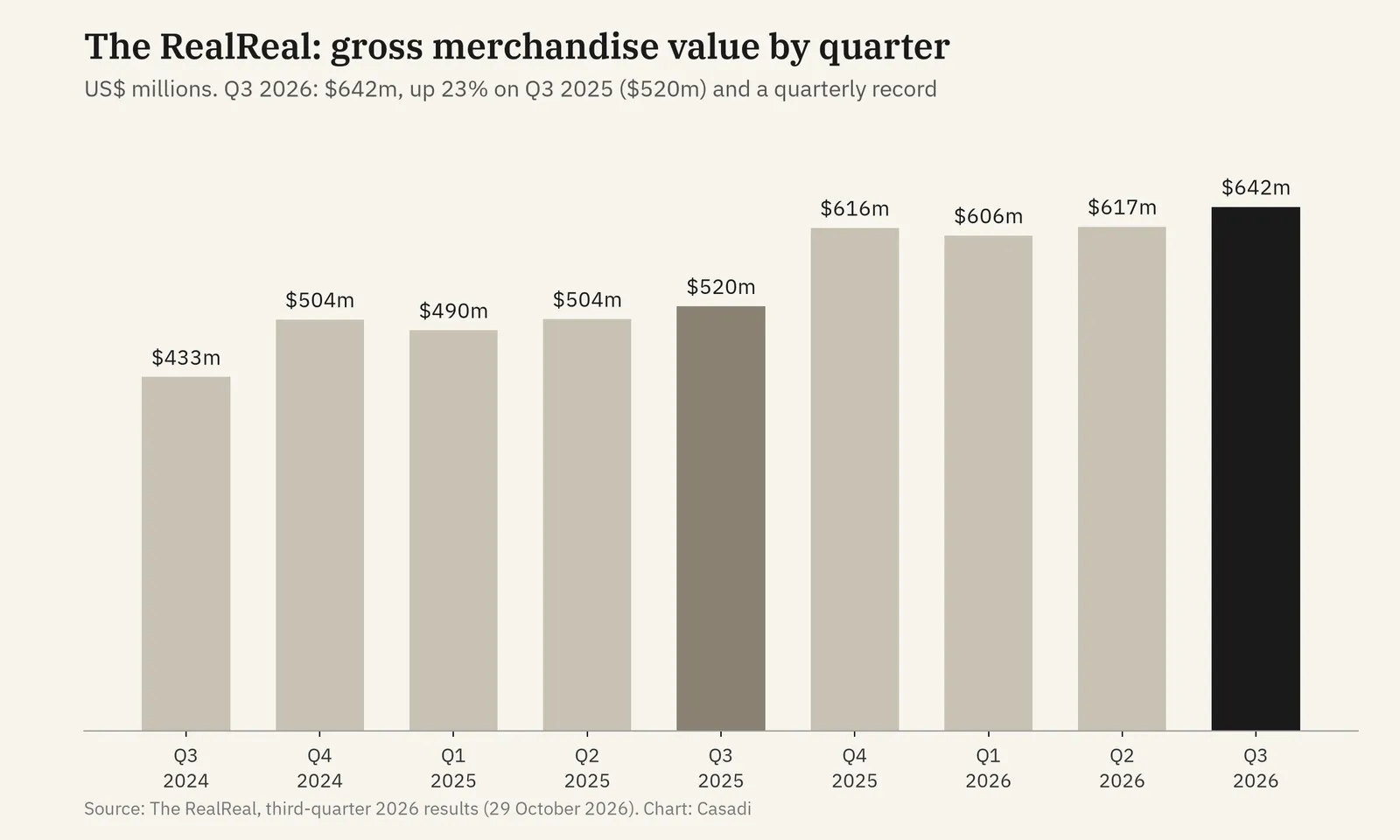
"Q3 was another record quarter for The RealReal, with quarterly all-time highs in GMV, revenue and orders," Levesque said in the results release. Customers, she added, "increasingly start their journey with us and engage well beyond the transaction, to discover what to buy, to track what they own, and to decide when to sell."
A raised outlook
The company now expects full-year GMV of $2.585 to $2.600 billion, revenue of $806 to $810 million and adjusted EBITDA of $71.1 to $72.6 million. WWD noted that the previous forecast was $788 to $797 million in revenue and $66 to $69 million in adjusted EBITDA. For the fourth quarter, traditionally the strongest, it guided to GMV of $720 to $735 million and revenue of $218 to $222 million.
Investors were encouraged. WWD reported that the shares rose 5.3% to $11.95 in after-hours trading, although they had closed the day down 28% for the year. The company also named Alexis Hoopes, formerly head of eBay's global fashion business, as chief merchandising officer, and said it had completed a refinancing earlier in October that extends its debt maturities.
The Birkin question
The RealReal does not break out sales by brand in its results, so its quarter says nothing directly about any one house. The wider market, though, is shifting. In its 21 October report, Reuters cited a September note from the brokerage Bernstein, which tracks auction results, estimating that Birkin 25 bags resold for about 1.7 times their retail price on average in the third quarter, down from about 2.6 times at the 2022 peak. UBS, which downgraded Hermès shares to sell this month, estimated that the number of Birkins and Kellys listed for sale worldwide is now six to seven times higher than before the pandemic. Fashionphile told Reuters its own Birkin listings have grown 32-fold in 15 years.
A premium of 1.7 times is still a premium, and not every dealer sees weakness: Fashionphile's founder, Sarah Davis, told Reuters that Birkin prices on her platform have held firm and even risen slightly this year. But the case for buying a Birkin as an investment rests on scarcity, and more supply weakens it. We looked at how the auction market for rare Hermès pieces has held up in our report on this year's Birkin auction records, and at the house's own trading in Hermès' third quarter.
Where the value is moving
If the most famous bag is losing some of its resale premium, others are gaining. Fashionphile's 2026 Ultra-Luxury Resale Report, summarised by TheIndustry.fashion on 14 October and comparing January to July with the same months of 2025, found that early-2000s revivals are driving prices up. The average sale price of the Saint Laurent Mombasa, Tom Ford's horn-handled 2001 design, rose 291%, and the average resale value of the Fendi Spy 127%. Among the established classics, the Chanel Double Flap's second-hand value rose 8.89%, the Hermès Kelly's 7.67% and the Birkin's 6.14%, while the Louis Vuitton Speedy was the platform's most-shopped bag for a second year.


The pattern is one of resale following fashion rather than simply storing value. Fashionphile attributed the Mombasa's revival to Anthony Vaccarello's recent runway homage, and searches for the Fendi Spy rose 104% on its platform. When a house revisits its archive, the original pieces in circulation are often the first to move.


What it means
The RealReal's quarter suggests that buying and selling second-hand has become routine for a large group of luxury shoppers, and that, on this season's results, the platforms serving them are growing faster than many of the houses whose goods they resell. For buyers, the shift is a reminder that resale value is not fixed: it depends on supply, on fashion and on condition. Before buying a pre-owned classic, read our guide to how to authenticate a Chanel Classic Flap, and for brand-by-brand figures, see our round-up of this year's handbag resale value reports.
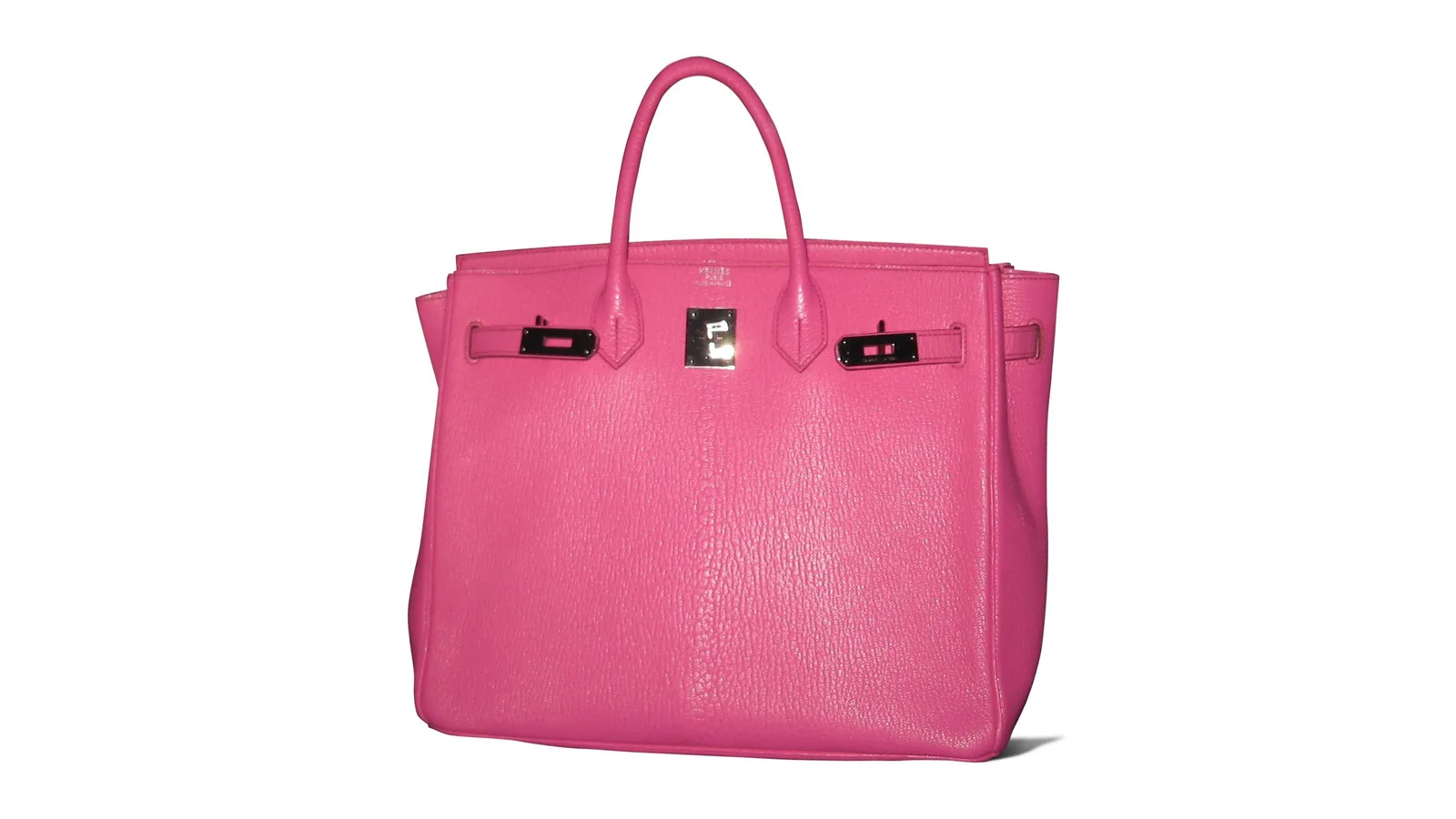
Featured image: Yvette Religioso-Ilagan (retouched by Jorgebarrios), CC BY 2.0, via Wikimedia Commons. Cropped for this page.
