Yves Saint Laurent was born on 1 August 1936 in Oran, in what was then French Algeria, and grew up in a comfortable family that encouraged his early interest in theatre and dress. At seventeen he moved to Paris and studied briefly at the Chambre Syndicale de la Couture. In 1954 he won first prize in the dress category of the International Wool Secretariat competition, the same year Karl Lagerfeld won for coats. Michel de Brunhoff, the editor of Vogue Paris, introduced him to Christian Dior, who hired him as an assistant in 1955.
When Dior died suddenly in October 1957, the house named Saint Laurent, then twenty-one, as its head designer. His first collection, in January 1958, introduced the Trapeze line, and it was a triumph that secured the house's future. His later Dior collections were more daring and less well received, including a 1960 collection inspired by the Left Bank beatniks. That year he was conscripted into the French army during the Algerian War, suffered a breakdown and was discharged, and Dior replaced him with Marc Bohan.
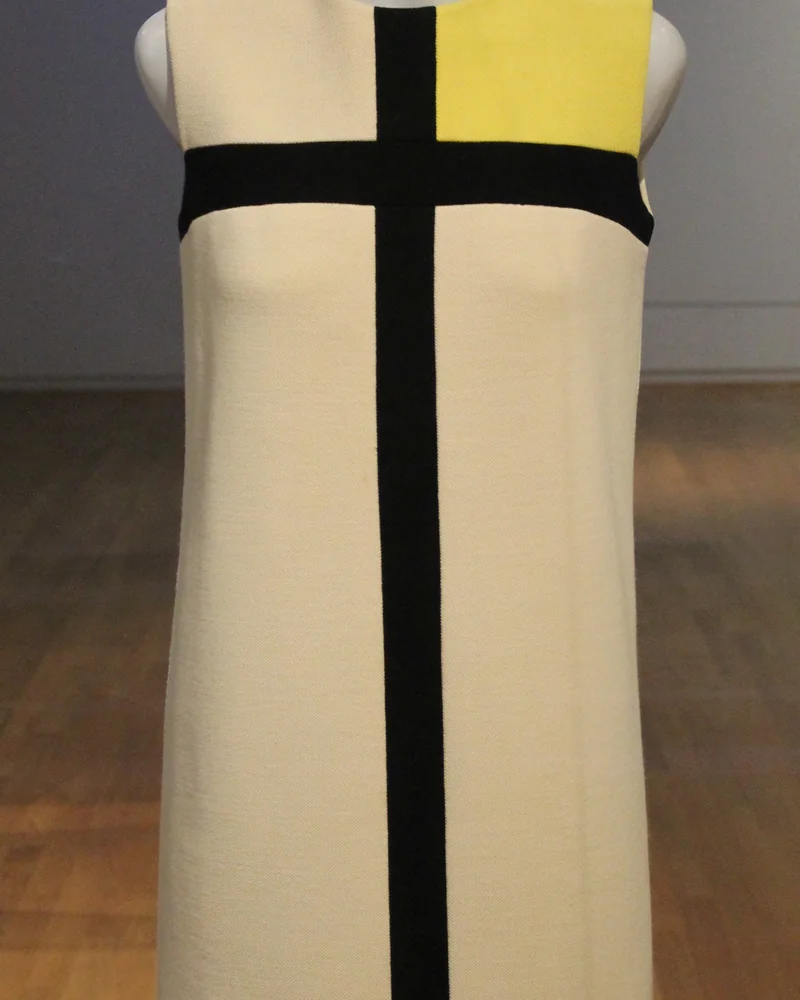
With his partner Pierre Bergé, Saint Laurent founded his own couture house, showing its first collection in January 1962. Over the next two decades he did more than any other designer to define how modern women dressed. In 1965 the Mondrian collection translated the painter's grids into simple jersey shift dresses. In 1966 came Le Smoking, the tuxedo for women, later immortalised by Helmut Newton's photographs. Then came the safari jacket and the jumpsuit, and the trouser suit made acceptable for city and evening wear. In 1966 he also opened Saint Laurent Rive Gauche, the first ready-to-wear boutique launched by a couturier under his own name, and made designer clothes available beyond the couture salon.
He drew on art, literature and travel. His collections paid homage to Picasso, Matisse, Braque and Van Gogh, and his 1976 Opéra–Ballets Russes collection was celebrated as one of the great couture shows. He also drew on Morocco, where he and Bergé bought the Jardin Majorelle in Marrakech in 1980 and restored it, and on Russia, China and Spain. In 1983 the Metropolitan Museum of Art held a retrospective of his work, the first devoted to a living designer, organised by Diana Vreeland.
His circle included the muses Loulou de la Falaise, Betty Catroux and Catherine Deneuve, whose clothes he designed for Belle de Jour. The business, built by Bergé, extended into fragrances such as Opium and accessories, and was sold to Sanofi in 1993. In 1999 Gucci Group acquired Saint Laurent's ready-to-wear and fragrance, with Tom Ford designing Rive Gauche, while Saint Laurent continued to design couture. He announced his retirement in January 2002 with a final retrospective show at the Centre Pompidou, and the couture house closed.
Saint Laurent struggled with depression and addiction for much of his life, which he spoke of in his retirement address. He died at his home in Paris on 1 June 2008, aged 71, and his ashes were scattered in the Jardin Majorelle. The Fondation Pierre Bergé–Yves Saint Laurent preserves his archive of drawings and garments, and in 2017 opened two museums: the Musée Yves Saint Laurent Paris, in his former couture house on avenue Marceau, and the Musée Yves Saint Laurent Marrakech.
The house he founded continues as Saint Laurent, part of Kering, with Anthony Vaccarello as creative director since 2016. Bergé, his partner in life and business, died in 2017, months before the museums opened.