Reginald Murray Williams was born on 24 May 1908 at Belalie North, near Jamestown in South Australia's Mid North, into a pioneering family that worked with and trained horses. When he was ten the family moved to Adelaide so that he and his sisters could go to school; it did not suit him, and at 13 he packed his swag and left for the bush. At 18 he became a camel driver, spending three years in the desert, living alongside Aboriginal people and learning to survive the country.
He learned leatherwork from an Aboriginal stockman, "Dollar Mick" Smith, making bridles, pack saddles and riding boots near Nepabunna in the northern Flinders Ranges, where he had been working with the United Aborigines Mission. Between 1932 and 1934 he ran a workshop employing Adnyamathanha people from the Nepabunna Mission, who played an important part in building the business. In 1932, needing money for his son's hospital treatment, he began selling saddles to the pastoralist Sir Sidney Kidman. In April 1934 he moved back to Adelaide and set up a small factory in his father's back shed at Prospect, which grew rapidly.
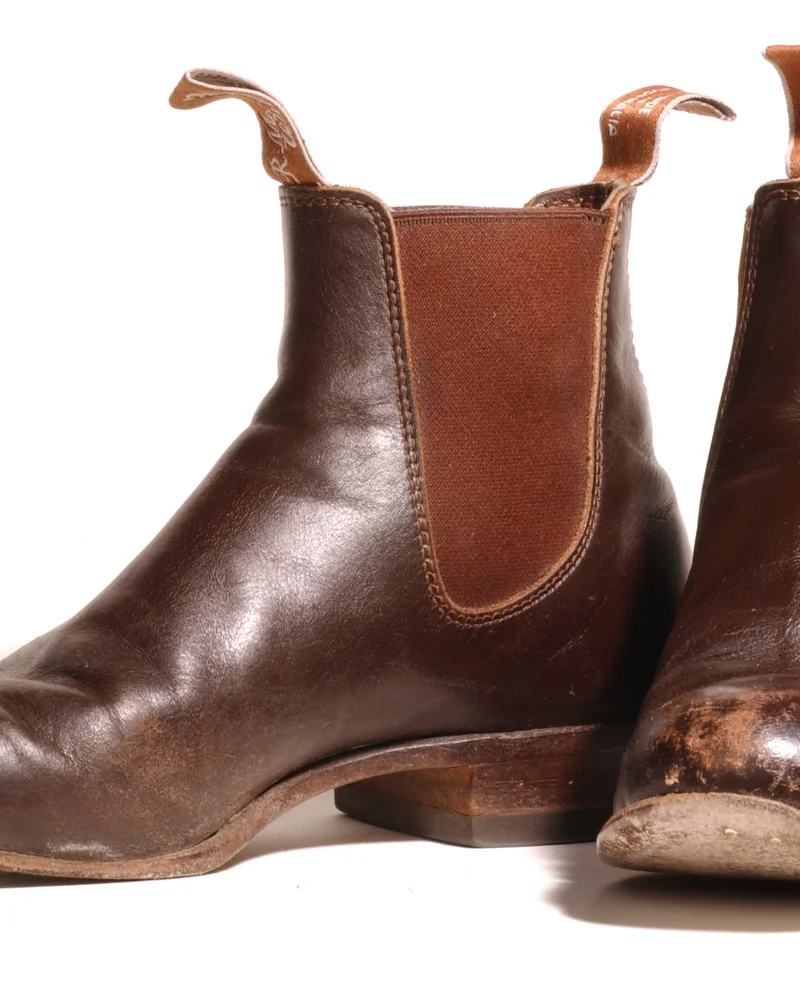
His most celebrated product was the hand-made riding boot, cut from a single piece of leather and stitched only at the back; the elastic-sided version became a classic. From these working origins R.M. Williams became a byword for Australian bush clothing and footwear recognised around the world.
He was always more than a bootmaker. "It was only ever an experience in making a dollar," he said of the boots. "The company was only ever a small part of my life." The Sydney Morning Herald's obituary listed him as bushman, camel boy, goldminer, drover, polo player, poet, publisher and more. After the Second World War he bought the Nobles Nob gold mine at Tennant Creek from a widow; it made him rich, and he later spent heavily on a tea plantation in the New Guinea highlands. The first pair of boots, made with Dollar Mick in a camp in the Gammon Ranges, set the method that endured: "We shaped them from one piece of leather, blocked while the hide was wet, into the shape of a foot." Customers across the outback ordered by post, sending outlines of their feet traced on cardboard, and Australian equestrian teams have worn his boots since the 1956 Melbourne Olympics. His business creed was simple: "If you make something good, people will make a track to your door."
Williams was also a publisher and a builder of institutions. He founded the magazine Hoofs and Horns in 1944, published a 300-page anthology of the bush poet Will H. Ogilvie, Saddle for a Throne, in 1953, helped form the Equestrian Federation of Australia in 1951 and founded the Australian Roughriders Association. He was a founding board member of the Australian Stockman's Hall of Fame at Longreach, opened by Queen Elizabeth II in 1988, and led the committee that planned the Bicentennial National Trail.
Control of the company passed out of his hands in 1988. After its owners went into receivership in 1994 it was rescued by his friend Ken Cowley, in partnership with Kerry Stokes, and later passed to the LVMH group, which in 2020 agreed to sell it to Andrew Forrest's Tattarang.
Williams was appointed CMG in 1985 for services to the outback community and an Officer of the Order of Australia in 1992, and received the Centenary Medal in 2001. The RM Williams Way in South Australia bears his name. He died in Toowoomba on 4 November 2003, aged 95, and was given a state funeral.